
Clinically reviewed by Chris Mosunic, PhD, RD, MBA, Chief Clinical Officer, Calm
Employers aiming to improve workforce well‑being face a difficult challenge: depression is both on the rise and highly complex. More than 18% of U.S. adults today report having depression or being treated for it, but how it shows up varies widely from person to person, making it challenging for organizations to address.
Yet research shows that organizations play an important role in both contributing to an employee’s depression as well as possibly mitigating its effect on employees. Specifically, a toxic work environment significantly increases the rate of employee depression, but perceived organizational support can significantly lessen its effects.
That means that employers can take a two-fold approach to combat employee depression: remove negative factors in the workplace that cause distress and also strengthen proactive support for employee wellbeing.
Rates of depression are historically high, with the sharpest rise seen among young workers
The percentage of US adults with depression has increased about eight percentage points in the past decade, with young adults experiencing the sharpest rise. According to Gallup, the rate of depression for adults under the age of 30 has more than doubled, from 13% in 2017 to 26.7% in 2025. Loneliness, student loans, the cost of housing, uncertainty about the future, and difficulty accessing mental health support are among the contributing factors.
Toxic workplace dynamics and events can also contribute to depression. According to research, work overload, poor communication, bullying, abusive supervision, and a lack of fairness, empathy, and emotional intelligence have been shown to increase the rate of employee depression, likely due to diminishing a person’s psychological wellbeing. Unfortunately, Calm’s survey of 4,000 employees found that about half (49%) feel negatively about their organization, using words such as “toxic” and “tumultuous” to describe their workplace.
What is depression? Not only one thing.
And just as there are myriad causes of depression, its symptoms vary too. “Depression isn’t only one thing,” says Dr. Alise Conner, a clinical psychologist, in Navigating Depression with Practical Tools, a Calm Health mental wellness program. “It looks different for different people. It can hit you fast, or sneak up quietly. It can happen once in your life, or once a year. It can interfere a lot, where you can hardly get out of bed, or a little, where a mellow sadness lingers inside of you.”
That said, common symptoms of depression include
- Persistent feelings of sadness or hopelessness
- A loss of interest in favorite activities
- A lack of energy and motivation, and difficulty caring for oneself
- Irritability
- Trouble sleeping
- Loss of appetite
- Headaches and other physical ailments
- Feelings of self-harm
How depression shows up in the workplace
Employees with depression may have trouble concentrating or making decisions. They may appear nervous or agitated and begin to withdraw.
In toxic work environments, employees struggling with depression may also experience elevated rates of stress, anxiety, and burnout. Innovation and productivity may suffer, and their loyalty to the organization may deteriorate, putting them at risk of quitting.
How employee depression affects organizations and the economy
Employee depression takes a huge toll on organizations and the larger economy. According to Gallup,
- Depression in the US is responsible for an estimated $23 billion loss in productivity each year.
- Employees diagnosed with depression miss an average of 8.7 workdays each year, compared to an average of 4.6 for employees not diagnosed with depression.
Despite the heavy toll of employee depression, most workers don’t believe their employer cares about them. In fact, less than one quarter of US workers strongly agree that their employer cares about their overall wellbeing. But improving that perception can make a positive impact on how employees are feeling and performing in the workplace.
Employers can take a two-pronged approach to combat employee depression
Removing common stressors associated with burnout and depression
First, to reduce the prevalence of depression across the organization, employers can take steps to minimize common workplace stressors that create it in the first place.
- Strengthen work-life boundaries
Feeling pressure to be “always on” is a major stressor in the workplace that can contribute to chronic stress and burnout, which can raise the risk of depression. Employers can establish technology-use guidelines to help employees protect their personal time from work, e.g., establishing a guideline to turn off application notifications at the end of the workday and on weekends, or allowing employees to block time during the day as meeting-free zones. - Manage work overload
To help tackle overwork and create a healthier workplace culture, employers can establish a data-driven planning process that helps leaders and managers set realistic goals and expectations based on the employees and resources they have. Employers also can give employees more control—i.e., autonomy, flexibility, and decision-making power in how they get their work done. A lack of employee control is associated with stress and burnout, according to Dr. Christina Maslach, professor of psychology at the University of California, Berkeley. - Foster a more empathetic and emotionally intelligent workplace
Caring, empathetic, and emotionally intelligent workers, especially managers, can make a positive impact on workforce mental health. Building mental health literacy and emotional awareness across the organization are two ways to get started.
Calm’s survey showed that employers’ top four emerging manager strategies are developing mindful managers, training managers to recognize mental distress, training managers to speak openly about mental health, and developing caring managers who lead with empathy and high emotional intelligence.
Demonstrating support for employee wellbeing with mental health resources
In addition to creating a more psychologically safe workplace environment, employers can provide accessible, stigma-free mental health resources. When organizations expand support, employees are more likely to feel cared for, which in and of itself helps reduce the likelihood that workplace stressors translate into employee depression. Resources to consider include
- 24×7 access to mental health screenings
Digital mental health screenings may enable employees to better understand the severity of their symptoms of depression and anxiety so they can get appropriate levels of support. Calm Health’s online mental health screening uses questions from the Patient Health Questionnaire 9 (PHQ-9), a screening for depression symptoms, and Generalized Anxiety Disorder (GAD-7), a screening for anxiety symptoms, and can be completed in just a minute or two. Upon completion, the user receives recommendations for support based on their screening results and self-reported information. (Calm Health’s screening is not a substitute for care by a physician or other healthcare provider.) - Digital mental wellness programs
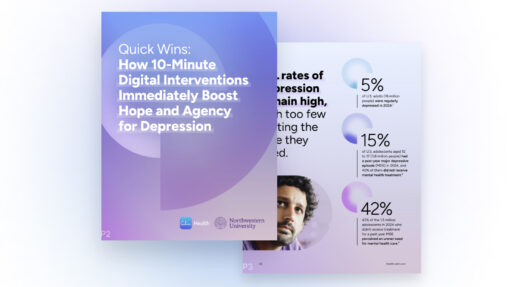
A study led by The Department of Preventive Medicine at Northwestern University Feinberg School of Medicine found that digital, self-guided single-session interventions (SSIs) boosted agency and hope right away. Calm Health offers a library of evidence-based programs to support employees experiencing stress, anxiety, depression, and other challenges.
For example, Navigating Depression with Practical Tools, uses techniques from Cognitive Behavioral Therapy, Acceptance and Commitment Therapy, and Dialectical Behavior Therapy to support people with depression. - Mindfulness practice
Research shows that mindfulness-based interventions, including practices such as breathing exercises and guided meditation, can reduce depressive symptoms by interrupting negative thought patterns, reducing rumination, and enhancing emotional regulation.
Calm Health offers a broad spectrum of mindfulness resources, including guided meditations, soundscapes, wisdom, and movement. - Support for building emotional awareness and intelligence
Emotional awareness is the foundation of emotional intelligence, according to psychologist and emotional intelligence (EQ) expert Dr. Daniel Goleman. It’s the critical first step in the process of building EQ.
Drawing on top emotional researchers’ work, Calm Health’s Emotions Check-Ins feature helps employees regularly practice building emotional awareness. Through guided prompts, employees can pause during the day to recognize and label their emotions. By integrating emotional check-ins into daily routines, Calm Health may help employees reduce stress, communicate and collaborate in healthier ways, and foster a culture of trust and empathy.
Northwestern University led a study to investigate the efficacy of 12 digital, self-guided single-session interventions (SSIs) for depression in American adults. See the promising results.
Get the infographic
A path forward for organizations grappling with depression
Employee depression is a growing challenge, but employers have meaningful levers to reduce its impact. By improving workplace culture and expanding access to digital mental‑health support, organizations can help employees feel cared for and strengthen overall wellbeing. When employers invest in both prevention and accessible support, they create healthier, more resilient workplaces.